The Value of "Not Yet"

There's a strange moment that almost everyone has lived through and almost nobody talks about honestly.
It's the moment you finally get the thing. The promotion. The house. The degree. The relationship. The number in the bank account. The recognition. Whatever version of "more" you were chasing hardest that year.
And for a while, maybe a few days, maybe a few weeks, you're lit up. You post the pic. You update the LinkedIn. You draft the humble-brag caption. You feel the weight of having arrived somewhere.
Then something quieter happens. The lit-up feeling fades. You start noticing the next thing you don't have. The thing that, last year, wouldn't have even been on your radar. And you start moving toward that one instead, as if the previous summit never happened.
The thing we were never told
We grow up being taught a very specific formula. Work hard, acquire more, and happiness will show up as the payoff. More degrees, more accolades, more money, more assets, more influence. The logic is that each rung up the ladder brings a proportional increase in satisfaction.
It doesn't. It never has. Every serious tradition that has studied the human mind, from the Stoics to the Buddhists to modern psychology, has reached the same conclusion from different angles. Desire, by its nature, requires something absent. The second you close the gap, the desire dissolves, and the mind, restless as ever, spawns a new one a little further out.
Jim Carrey said it better than anyone in his 2014 commencement speech at Maharishi University of Management. The line gets quoted a lot, but it's worth sitting with:
"I've often said that I wished people could realize all their dreams of wealth and fame so they could see that it's not where you'll find your sense of completion."
That sentence is a gift. A man who has lived the full fantasy, every box checked, every dream realized, telling a room full of young people that the fantasy is a trap. Not because the things aren't nice. They are. But because the things were never what we actually wanted. We wanted the feeling we thought the things would give us.
Acquiring the thing doesn't deliver the feeling. If anything, acquiring the thing proves the feeling wasn't in the thing at all. Which is a cruel lesson to learn late in life, with a full garage and a hollow chest.
So what do we chase instead?
This is where Viktor Frankl becomes essential reading, and not optional.
Frankl was a Viennese psychiatrist who survived three years in Nazi concentration camps. His wife, his parents, and his brother did not. When he came out, he wrote Man's Search for Meaning in nine days. It has sold more than ten million copies because it answers, with brutal earned authority, the question that every other self-help book dances around: what actually makes a human life feel like it matters?
Frankl's answer, drawn from logotherapy, is that meaning comes from three sources, not from achievement.
The first is work, specifically work that is creative in nature and aligned with something larger than yourself. Not the title. Not the paycheck. The act of bringing something useful into existence in service of an idea you care about.
The second is love, which he meant in the broadest sense. The deep knowing of another person. The service of their flourishing. Not romance alone, but the full human capacity to see another being clearly and act for their good.
The third is courage in the face of unavoidable suffering. The hardest of the three and the most distinctively human. The freedom to choose your attitude when the circumstances allow no other freedom at all.
Notice what's missing from that list. Accomplishments. Credentials. Status. Wealth. Followers. The markers we've been trained to optimize for our entire lives don't show up in Frankl's framework, and he earned the right to make that list in a place where all those markers were stripped away and found to be worthless for the task of staying human.
The right kind of unreachable
Our ideals have to be slightly unreachable on purpose. If you can fully achieve the thing you're aiming at, it was the wrong thing. Not wrong in the moral sense. Wrong in the sense that it was too small to organize a human life around.
The useful ideals are the ones that keep receding as you approach them. A better version of yourself. A field that is more just than you found it. A contribution to a body of work that your successors will keep building after you're gone. A family you raise well. A problem so hard that your generation only moves it ten percent. These aren't things you finish. They're things you serve.
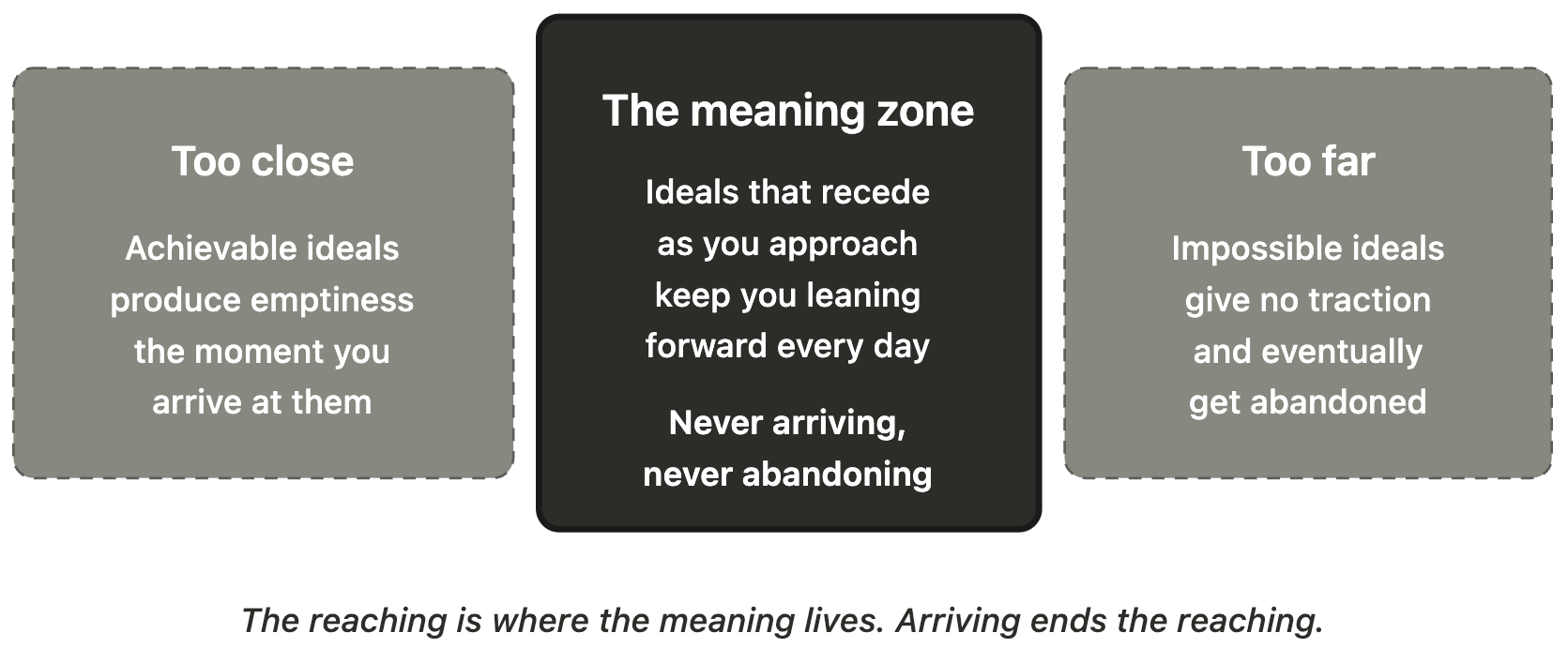
If the ideal is too close, you'll reach it and be empty on the other side. If it's too far, you'll never get close enough to feel traction and you'll give up. The right ideal is the one that keeps you leaning forward every day of your life, never arriving, never abandoning.
That's not a failure mode. That's the design.
Which brings me back to the biggest work
Recently, we wrote about why we never give up on fusion. Why private capital and national labs and billionaires keep pouring billions into a technology that has been thirty years away perpetually.
The surface answer is energy. The deeper answer is the one we're writing about today. Fusion is exactly the right kind of unreachable. A generation of engineers is spending their lives on it, knowing most of them will retire before the first commercial plant comes online. And they do the work anyway. With joy, even. Because the work is the point. The star on earth is the point. The reaching is the point.
The same is true of any work worth doing. The teacher who spends thirty years shaping students whose lives they will mostly lose track of. The founder building something the market won't understand for a decade. The researcher publishing a paper they know will be one brick in a wall that will stand for centuries. The parent raising a child whose adult life they may not live to see.
None of them are optimizing for achievement. All of them are living inside Frankl's first category, work in service of something larger than the self.
So no, we must never fully achieve what we seek. Because the day we do, the reaching stops, and the reaching is where the meaning was the whole time.