Why we never give up on Fusion
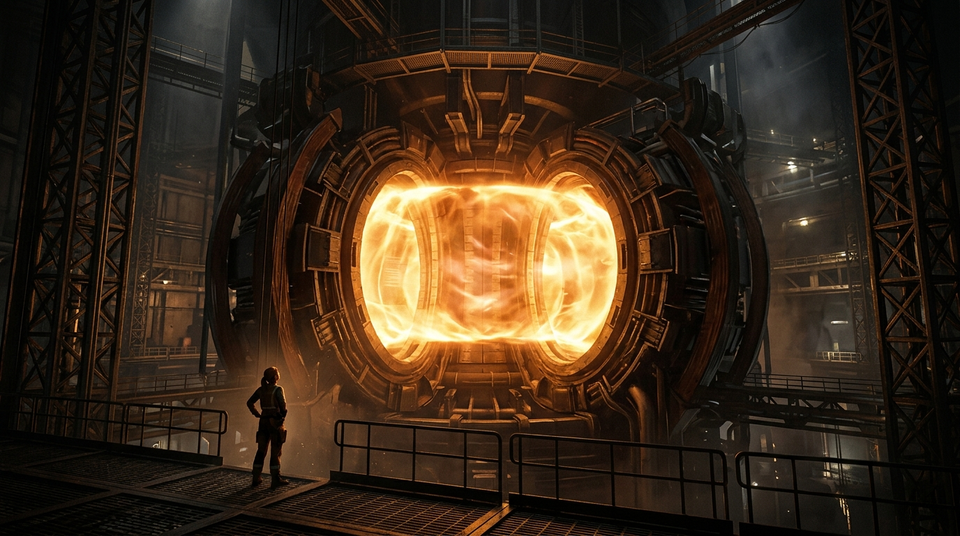
Fusion is the oldest joke in energy. Always thirty years away. Always the holy grail. Always burning through another billion dollars of someone else's money.
Except the joke stopped being funny sometime in the last few years, and I don't think most people have noticed yet.
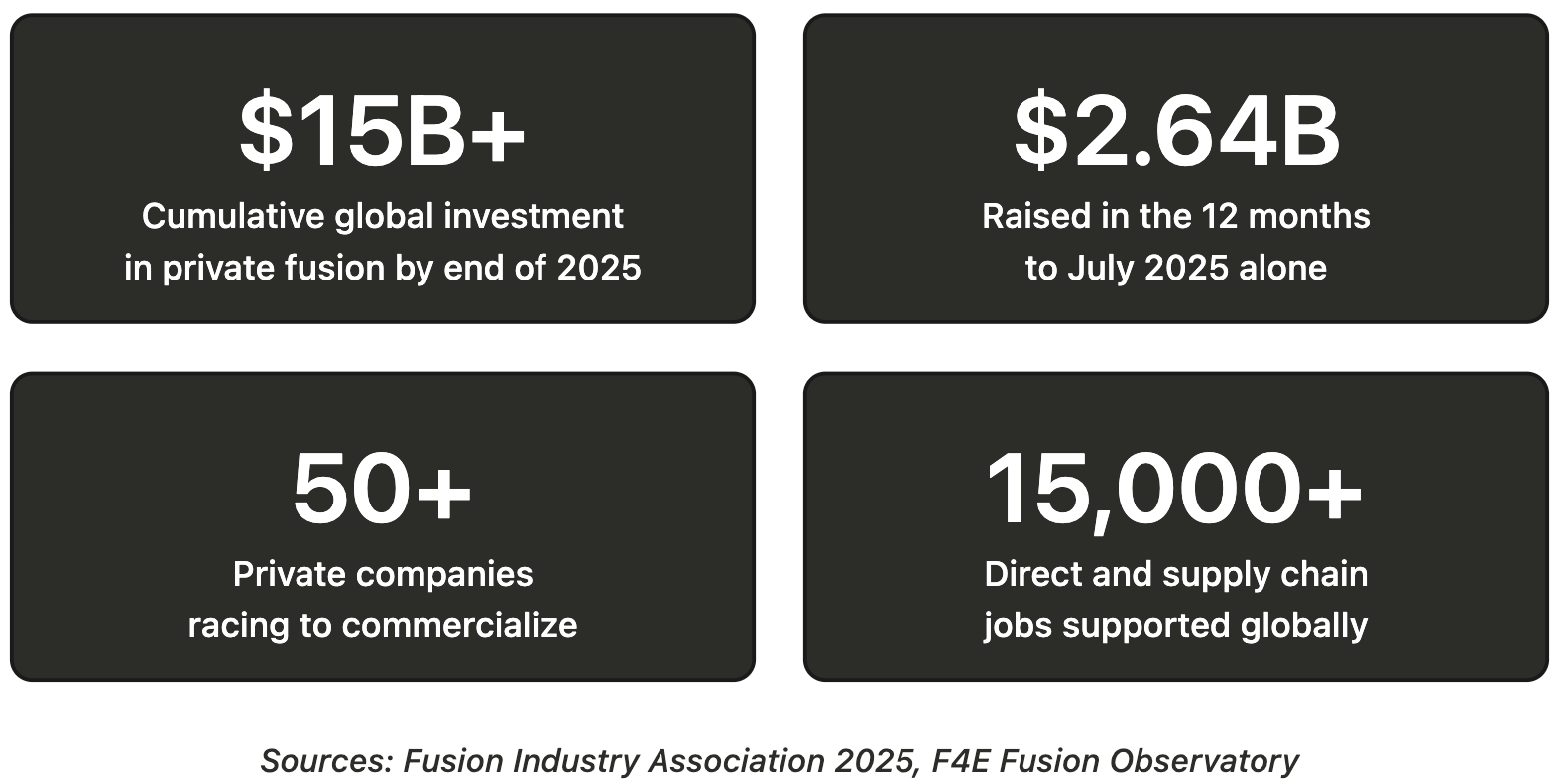
Private fusion companies raised $2.64 billion in the twelve months to July 2025, and cumulative global investment crossed $15 billion by the end of that year. The Fusion Industry Association counts more than 50 private companies in the race, employing over 5,000 engineers directly and supporting another 10,000 in the supply chain. One of the oldest private fusion companies is going public on the Nasdaq. Jeff Bezos, Bill Gates, Peter Thiel, Google, Microsoft, Chevron, and Nucor all have money in the game. Steel plants and data centers have already signed power purchase agreements for fusion electricity they expect to start drawing in the early 2030s.
That's not a field waiting for a breakthrough. That's a field pricing in the next one.
So why do we keep chasing it?
Because fusion is one of the hardest problems humans have ever set for themselves, and the payoff is the kind of thing that rewrites civilization.
We are, quite literally, trying to build a star on Earth. To take the same reaction that powers the sun and contain it inside a machine small enough to plug into a grid. If we pull it off, the consequences stack in a way that nothing else in our energy portfolio can match.
Abundant, clean baseload power means barren land can become agricultural. It means every nation can have its own energy source, removing one of the oldest reasons countries have gone to war. It means we can run desalination and direct air capture at scales that actually matter, not pilot-plant scales but continental scales. It means interplanetary travel we've only seen in movies becomes something an engineer can sketch on a whiteboard instead of a screenwriter dreaming. It's not just another power source. It's a step change in what our species is capable of.
That's why we don't give up.
But what changed? Why now?
For decades, fusion was a physics problem. A terrifyingly hard one. You need to heat a plasma to a hundred million degrees, hotter than the core of the sun, and then hold that plasma in a shape you want, in a machine that doesn't melt, for long enough to get more energy out than you put in. The physics was understood. The engineering was brutal.
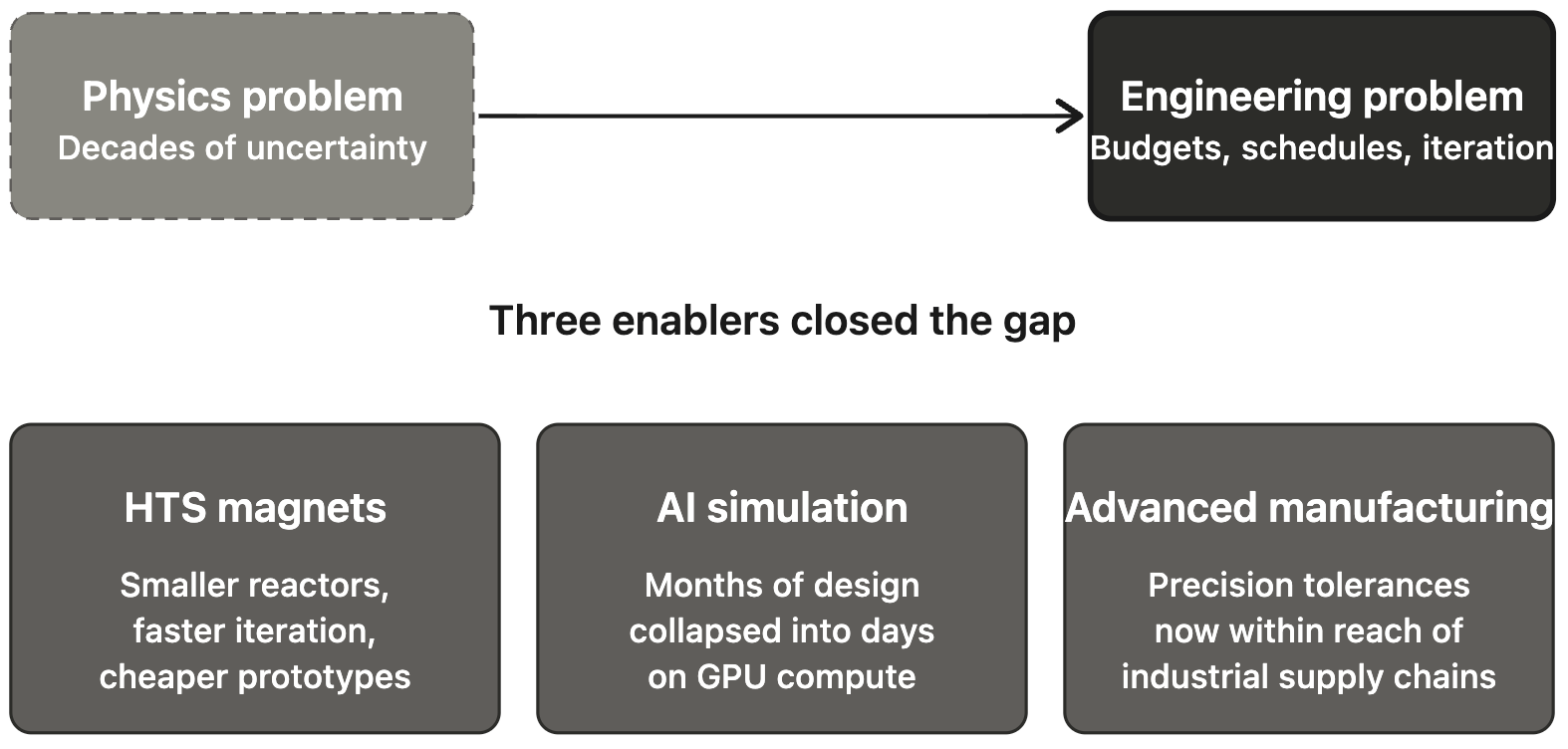
What's different now is that fusion has crossed the line from a physics problem into an engineering one. That's a quiet distinction, but it's everything. Engineering problems have budgets. They have schedules. They have the kind of iterative, test-and-refine discipline that modern industry actually knows how to run.
Three things pushed us across that line.
High-temperature superconducting magnets. Commonwealth Fusion Systems and others have built magnets strong enough to confine plasma in machines an order of magnitude smaller than the old designs. Smaller means cheaper, cheaper means faster iteration, faster iteration means real engineering progress instead of decades-long experiments.
AI-accelerated simulation. Plasma physics is too complex to solve by hand and was too expensive to simulate until recently. Modern machine learning and GPU compute have collapsed design cycles that used to take months into days. You can try a hundred reactor geometries in the time it used to take to try one.
Advanced manufacturing. The precision tolerances fusion requires used to be one-off craftsmanship. Now they're within reach of industrial supply chains. The National Ignition Facility crossed scientific breakeven in late 2022, producing more energy from a fusion reaction than the lasers delivered to the fuel pellet. That was the moment the science stopped being the blocker.
Three decades ago, fusion was waiting on a physics breakthrough. Today it's waiting on industrial execution. Those are very different kinds of waiting.
And the money tells its own story
Capital is the cynic's truth serum. It doesn't care about your thesis, your vision, or your poetry. It cares about risk-adjusted returns. So when venture capital firms, sovereign wealth funds, industrial giants, and the richest individuals on Earth are all writing checks to fusion startups at the same time, that's worth paying attention to.
They're not investing because they love plasma physics. They're investing because their businesses, especially AI data centers, are staring down an energy crisis that nothing else in the pipeline can plausibly solve. Microsoft signed a power purchase agreement with Helion for 50 megawatts by 2028. Nucor is backing a Helion plant to power steelmaking directly. Google expects to draw from a Commonwealth Fusion Systems plant in Virginia in the early 2030s. These aren't philanthropic bets. They're procurement contracts dressed up as venture rounds.
And here's the deeper reason those contracts matter. If fusion works at scale, we don't just get clean electricity. We get electricity so cheap and so abundant that we can afford to pull carbon directly out of the atmosphere at gigaton scale. Every decade of emissions we've loaded into the air becomes undoable, not just pausable. That changes the climate conversation from damage control to restoration.
The part that isn't on the spreadsheet
Even with all the math, the markets, and the milestones, none of it explains why fusion grabs people the way it does.
Because reaching for the stars is woven into whatever it means to be human. Every generation is supposed to build something the previous one couldn't. The moon landing, the internet, the genome, the vaccines developed in under a year. We measure ourselves by the impossible things we chose to do anyway, and then pulled off. Fusion is the next one in that line.
When talking to engineers who've spent their whole careers inside this problem, nobody talks about the earning potential or the accolades to come. They talk about the first time they saw plasma confined in a machine they helped build. They talk about the generations of their own teachers who never got to see it work. They talk about the obligation they feel to finish what people who taught them started.
That's not a business case. It's closer to a covenant.
So are we there yet?
Not quite. The next five to ten years will be decisive. Several companies are targeting net-electricity milestones before 2030. The first utility-scale plants are being sited now. Some of the bets will fail. Some of the approaches will turn out to be dead ends. That's how hard things get built.
But the shape of the answer has changed. We stopped asking whether fusion is possible years ago. The question now is who gets there first, what the plant looks like, and whether our regulatory and grid systems are ready for the energy abundance when it arrives.
That's why we never give up. Because the thing on the other side of this effort isn't just cheaper power. It's a different civilization.
And we're closer than we've ever been.