What AI will Actually Change in Industrial Automation
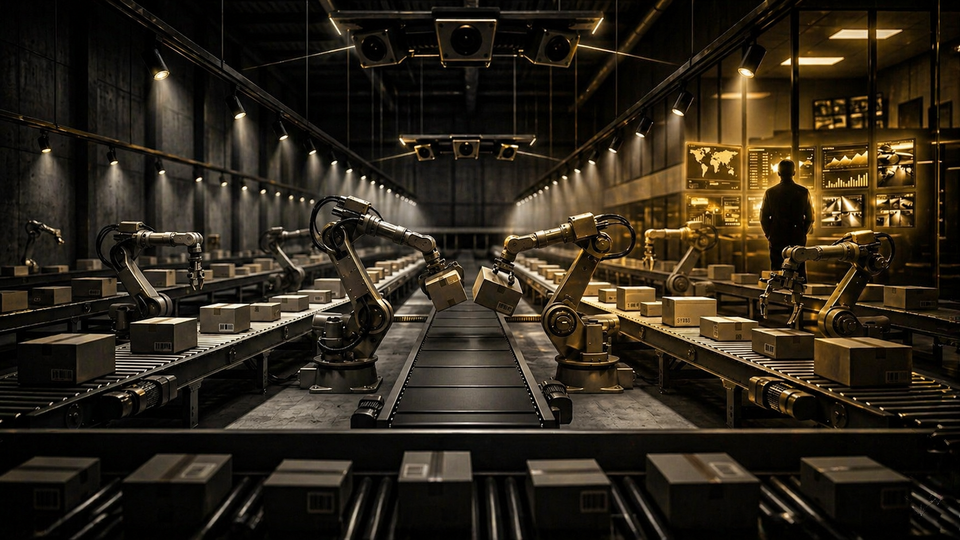
Walk onto a modern production floor and you'll hear the same thing you heard ten years ago. Belts humming. Motors cycling. The occasional alarm when a machine hits a fault state. From the outside, not much has changed.
But step into the control room and watch the screens. The sensors are denser. The feedback loops are tighter. And somewhere in the stack, quietly, a model is making machine-level decisions that no human ever touches.
That's the part of the story most people are missing when they ask “when is AI coming for industrial automation?" The question is already out of date. The better question is: what will AI actually change, and what won't it touch for some time? We're closer than most people think.
Gartner named Physical AI one of its top strategic technology trends for 2026, describing it as intelligence that powers machines and equipment to sense, decide, and act in the real world. That framing matches what we’re seeing on the ground. This isn't coming. It's here, in pieces, and the pieces are starting to connect. Not to autonomous factories. Not to the robot-utopia keynote slide. But to a quieter, more interesting shift that's already in motion.
The question everyone is asking wrong
Most AI-in-industrial-automation conversations get stuck in one of two failure modes.
The first is the utopian pitch. Fully autonomous plants by 2030. Dark factories. Workers replaced wholesale. This is marketing fiction written by people who have never stood on a floor at 2am trying to figure out why a sensor keeps dropping out.
The second is the dismissive shrug. "It's just machine learning with a new name." "We've had PID loops for decades." "Call me when it can handle a real-world edge case." This is usually said by smart veterans who have been burned by vendor demos that quietly fall apart once real throughput hits.
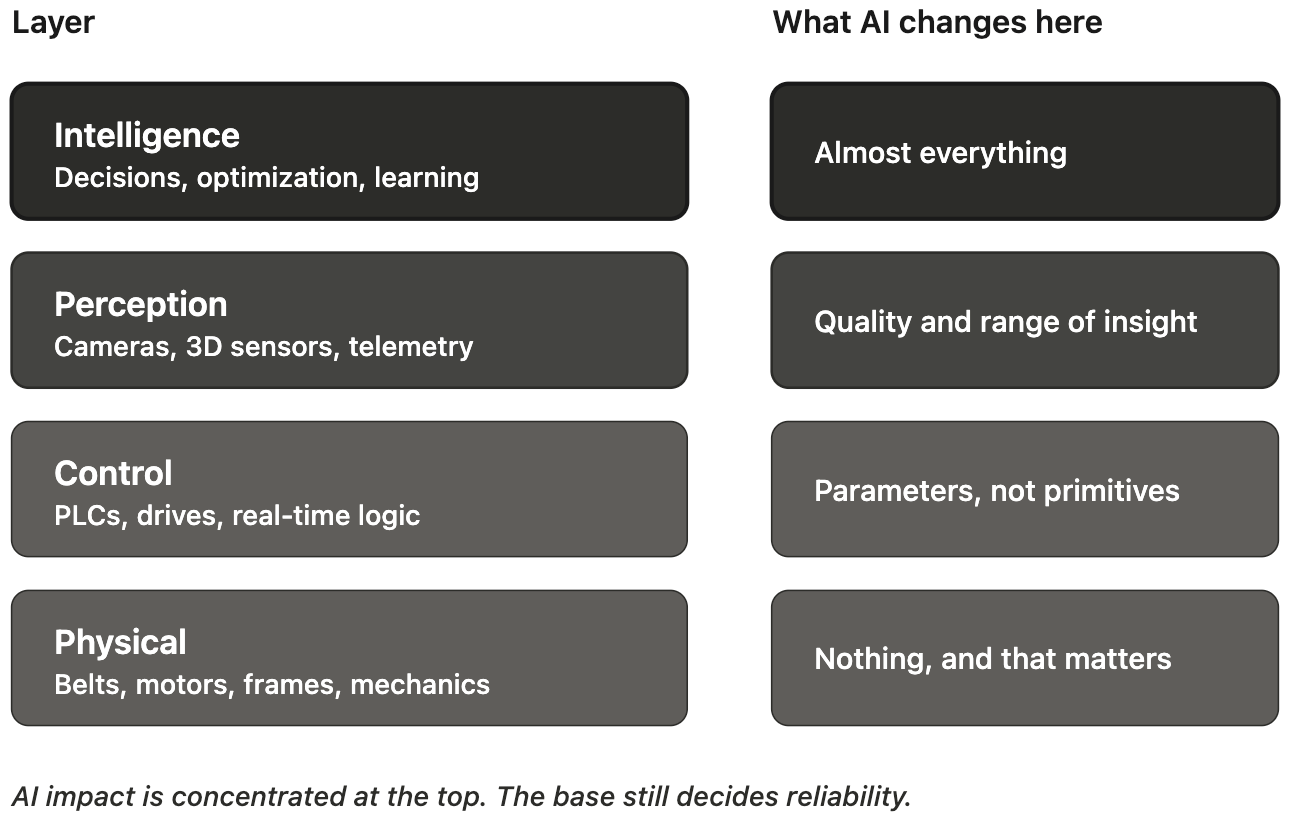
Both camps miss the same thing. AI isn't arriving in industrial automation as a single event. It's arriving in layers, and the layers show up on very different timelines.
What AI is already doing (quietly, right now)
The parts of industrial automation that AI is already changing share three traits. They involve high volumes of sensor data. They deal with variability that traditional logic handles poorly. And they tolerate occasional imperfection because a human is still in the loop somewhere downstream.
A few examples of where this is real today, not hypothetical:
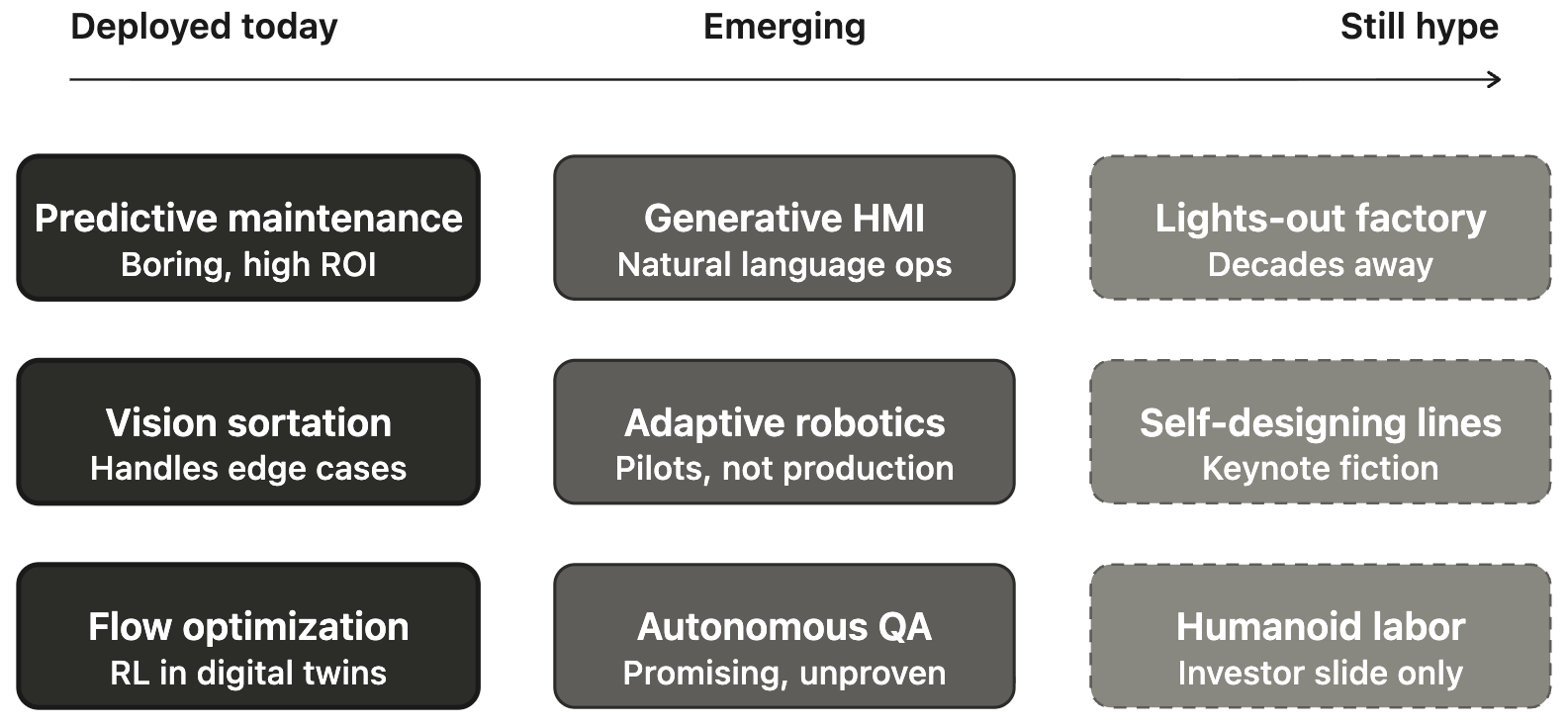
Throughput optimization. Material handling systems have historically run at fixed speed profiles, tuned once and left alone. Modern controllers can now adjust those profiles in real time based on what the sensors are seeing, smoothing out the kind of variability that used to require manual intervention. The math isn't new. What's new is that we can train these controllers in simulation before they ever touch a real machine, at a speed and scale that makes them viable in production.
Vision-driven inspection. Camera systems used to reject anything that didn't fit a clean rule set. AI vision handles the messy cases, items that are damaged, misoriented, or partially obscured. Not perfectly. But well enough that the operator's job shifts from "handle every case" to "handle the ones the system flags."
Predictive maintenance. Vibration signatures, current draw, heat profiles. Classical monitoring needed someone to set thresholds by hand. ML models find patterns humans would never spot and catch failures before they cascade. This is one of the most boring applications of AI in automation, and also one of the highest ROI. McKinsey research shows predictive maintenance can reduce maintenance costs by 10 to 40% and cut unplanned downtime by up to 50%. Those aren't projections. They're measured outcomes from deployments already in the field.
None of this is science fiction. It's in production, today, on real lines.
What AI won't change anytime soon
Here's where I part ways with the optimists who think we're a firmware update away from lights-out operations.
Physical reliability still wins. A belt that jams once a shift will destroy any amount of clever software on top of it. AI doesn't fix mechanical design. It exposes how brittle most of our mechanical design actually is.
Edge cases eat timelines. A model that handles 99% of cases beautifully will still need a year of engineering work to handle the last 1%, and that last 1% is what determines whether the business case actually holds up. This is the part vendor demos never show.
Safety certification is the real bottleneck. You can train a model to make a decision in 15 milliseconds. Convincing a safety engineer, a regulatory body, and an insurance carrier that you should trust it to do so, on a machine that can hurt someone, takes years. This is not a bug in the process. It's the process working correctly.
The workforce transition is slower than the technology. The operator on the floor needs the new system to feel intuitive on day one. If it doesn't, adoption stalls regardless of how elegant the underlying model is. Industrial AI wins or loses on the operator interface, not the algorithm.
The readiness gap nobody talks about
The real readiness question isn't technical. It's organizational.
Most industrial operators have world-class mechanical and electrical engineering teams. They have solid controls and programming talent. What they don't have, yet, is the connective tissue between those disciplines and the data science and ML engineering that modern AI applications require. The people who know the machines don't speak the same language as the people who know the models. And the people who know both are rare enough to be a bottleneck on their own.
The World Economic Forum's Future of Jobs 2025 report found that 63% of employers identify skills gaps as the primary barrier to business transformation, and estimates 39% of core skills will change by 2030. In industrial settings, that shift is sharper, not softer. Gartner echoes the same concern, flagging that Physical AI adoption will require new skills bridging IT, operations, and engineering, disciplines that have historically reported to different executives and rarely sat in the same room.
Closing that gap is the work of the next five years. Not building better models. Building the teams that can deploy them responsibly on systems that can't afford to fail.
So, is it already here?
Yes and no, and that's the honest answer. The technology is further along than the skeptics admit and less magical than the hype suggests. The companies that will pull ahead in the next few years aren't the ones with the fanciest AI roadmaps. They're the ones quietly hiring the people who can translate between the floor and the model, and who understand that industrial AI is won in the last 1%, not the first 99%.