Quantum Computing, the other revolution that isn't AI
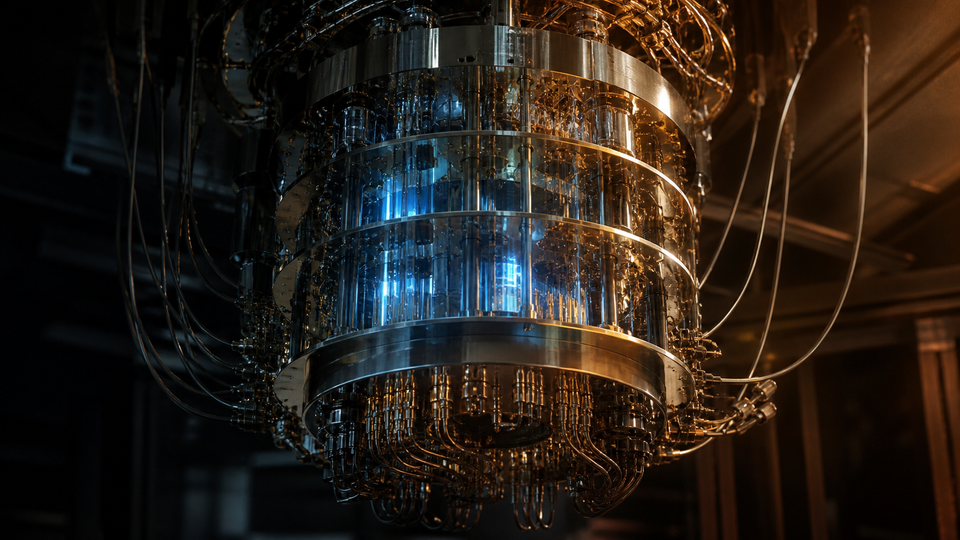
A quantum computer, the kind IBM and Google are building right now, has to be cooled to fifteen millikelvin. That's colder than deep space. The chip itself sits inside a multi-stage refrigerator the size of a small car, suspended in vacuum, shielded from every form of vibration the modern world produces. One stray photon can corrupt the calculation.
Most of the oxygen in computing right now belongs to AI. Models, agents, GPUs, training runs. That's where the money is, where the careers are, where the headlines live. Quantum is on a different track entirely. IBM is targeting verified quantum advantage by the end of 2026. Google is publishing peer-reviewed results in Nature showing logical qubits that get more reliable as the system scales. Microsoft is delivering a fifty-logical-qubit machine to its first customers. Global investment has reached $17.3 billion, up from $2.1 billion just four years ago.
A useful clarification before going further: quantum computing is not a faster classical computer. It is not coming for your laptop. It will not replace the chip in your phone. Treating it as the next generation of general-purpose computing is the surest way to misunderstand what it actually is, and what it's worth.
What is quantum mechanics, in plain language
Think of a classical computer the way you'd think of a coin that has already landed. It is heads or it is tails. Every photo, every email, every line of code you've ever used is, at the lowest level, billions of these settled coins arranged in patterns.
A qubit is a coin that is still spinning in the air. While it spins, it is not heads and not tails. It is something in between, a kind of weighted blend of both possibilities at once. The instant you grab it and look, it commits to one answer. But while it's spinning, you can do useful math with all the possibilities it represents.
That property is called superposition, and it scales in a way classical bits cannot. Two spinning coins represent four possibilities at once. Ten represent more than a thousand. A hundred represent more states than there are atoms in the observable universe. The art of quantum computing is designing problems so that, when all the coins finally land, they are far more likely to land on the right answer than the wrong one.
The other key property is entanglement. Two qubits can be linked so that the moment you look at one, you instantly know something about the other, no matter how far apart they are. Einstein called it "spooky action at a distance." It is one of the strangest ideas in physics, and it is much of what gives quantum algorithms their power.
These two properties, superposition and entanglement, are the engine. Everything else is engineering around them.
At least that’s what we think, cause as the famous physicist and Nobel laureate Richard Feynman once said
“If you think you understand quantum mechanics, you don’t understand quantum mechanics”
Why this isn't a competition with GPUs
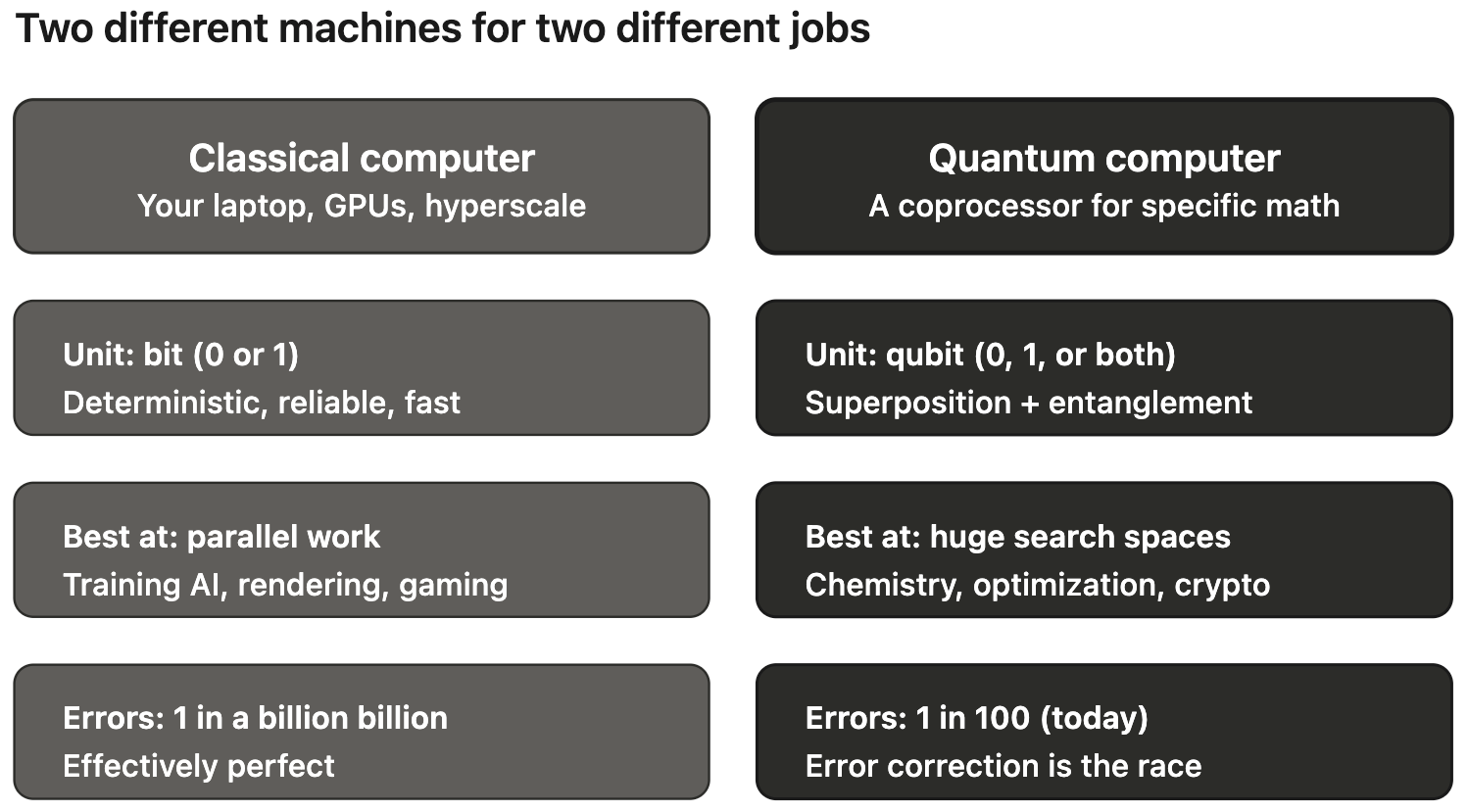
Quantum computers are not racing to beat your GPU at video games or large language models. They are not on a collision course with NVIDIA. The two technologies are good at fundamentally different things.
Classical computers, including modern GPUs, are extraordinary at problems where you can break the work into many similar tasks running in parallel. Training neural networks. Rendering graphics. Running simulations. The recipe is the same: do a known operation a few trillion times, very fast, very reliably.
Quantum computers are designed for a narrow set of problems where the math itself maps onto the physics of superposition and entanglement. Searching enormous spaces of possibilities. Finding patterns inside molecular interactions. Factoring numbers in ways classical algorithms struggle with. For everything else, classical wins, and will keep winning.
The right mental model is that quantum is a coprocessor for a specific class of problems, the way a GPU is a coprocessor for graphics and AI workloads. The future is hybrid. Classical handles the bulk. Quantum plugs in for the narrow cases where it offers a real advantage.
What is quantum actually good for
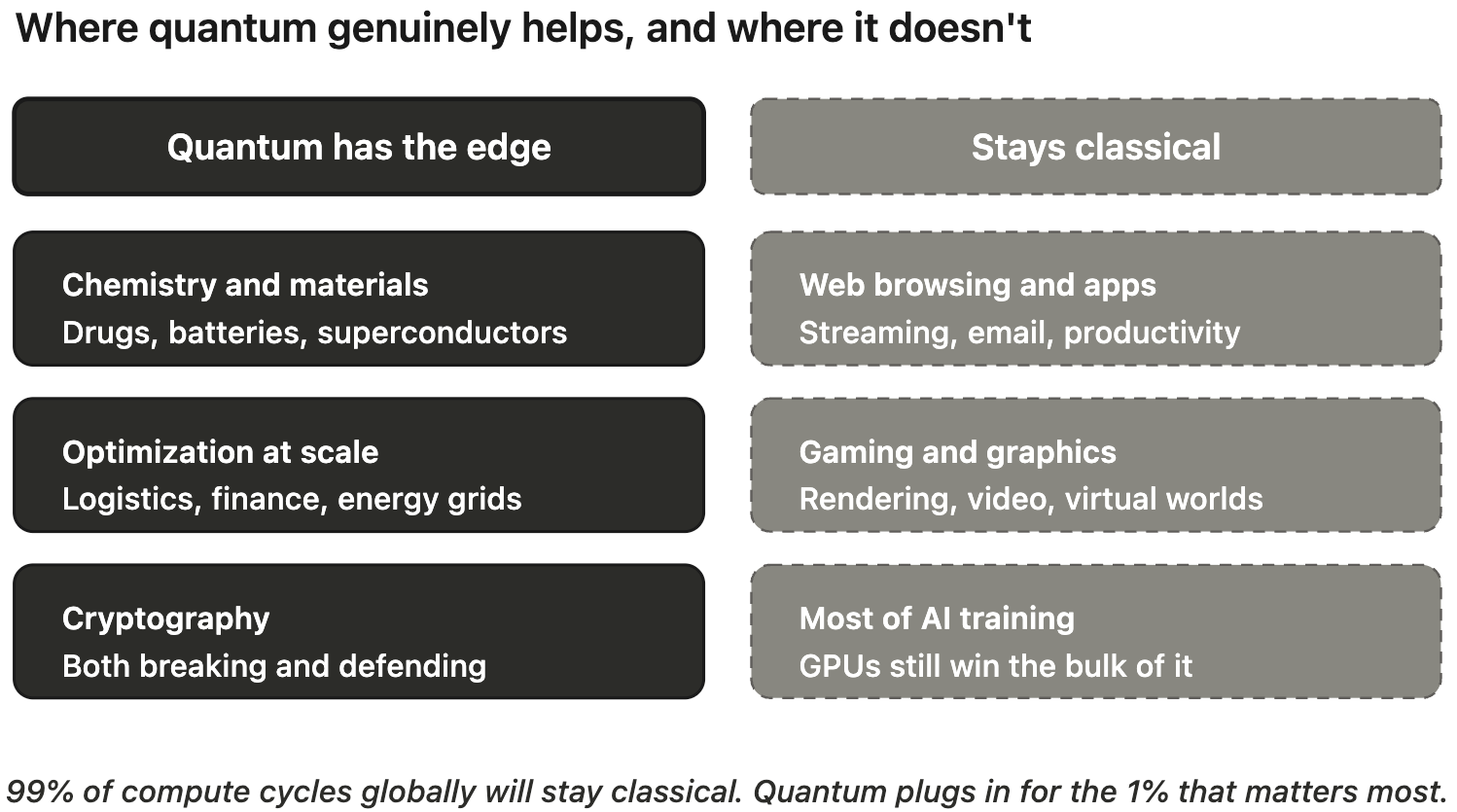
The use cases that survive scrutiny are surprisingly specific.
Chemistry and materials science. Simulating how molecules interact is one of the hardest problems in classical computing because the math grows exponentially with molecule size. Quantum systems are made of the same physics, so they can represent these interactions natively. Drug discovery, battery chemistry, and the search for room-temperature superconductors all live here.
Optimization at scale. Logistics networks, financial portfolios, traffic flow, energy grids. Problems with billions of possible configurations where finding the best answer fast is worth real money. IBM has demonstrated quantum advantage on certain optimization problems where their algorithms find solutions one hundred to one thousand times faster than classical methods.
Cryptography, in two directions. Quantum computers running Shor's algorithm could one day factor the large prime numbers that secure most internet traffic. That's the threat. The opportunity is post-quantum cryptography, new encryption designed to resist quantum attacks, now a national security priority in most major economies.
Specific machine learning problems. Sampling, kernel methods, certain generative models. Not all of AI, but specific corners where quantum offers real speedup. The future is hybrid quantum-AI workflows, not standalone quantum AI.
What's not on the list, and probably never will be: web browsing, video streaming, word processing, gaming, the day-to-day workloads that fill 99% of compute cycles globally.
Where the technology actually stands
The honest read on commercialization in 2026 is that we are in the middle innings, not the late ones.
Today's machines are what researchers call NISQ, noisy intermediate-scale quantum. Hundreds to thousands of physical qubits, but those qubits are fragile. Tiny disturbances cause errors. Classical computers run with error rates around one in a billion billion. Today's quantum hardware runs at roughly one in one hundred. The gap is enormous.
The race is to correct errors. By grouping many physical qubits into a single logical qubit, you can detect and correct errors as the computation runs. Google has demonstrated that adding more physical qubits to a logical qubit actually reduces the error rate, crossing a threshold researchers chased for decades. IBM's Starling system, scheduled for 2029, will provide 200 logical qubits built from roughly 10,000 physical qubits.
Verified quantum advantage, the moment a quantum computer demonstrably solves a useful problem better than any classical computer, is targeted by the end of 2026. Fault-tolerant quantum computing arrives by 2029. Large-scale fault-tolerant systems with thousands of logical qubits are likely a 2033 to 2035 story.
That timeline matters. The hype cycle will peak at exactly the moment the technology starts to show real value, which is exactly when overpromising will do the most damage to the field's credibility.
The patient case
Quantum computing will matter, but in a specific way. It will not replace classical computing. It will not break encryption next year. It will not power your phone.
It will become a coprocessor for a specific class of problems where it offers genuine advantages. The people who understand which problems those are, and which they aren't, will be the ones who deploy it usefully when it's ready. Everyone else will spend the next decade chasing applications quantum was never going to be good at, and missing the ones it was.
The right response to the technology isn't excitement or skepticism. It is patience and specificity. The other revolution is real. It is just a different shape than the AI one.