The Buildings that will Run the Next Decade, where AI Models Live
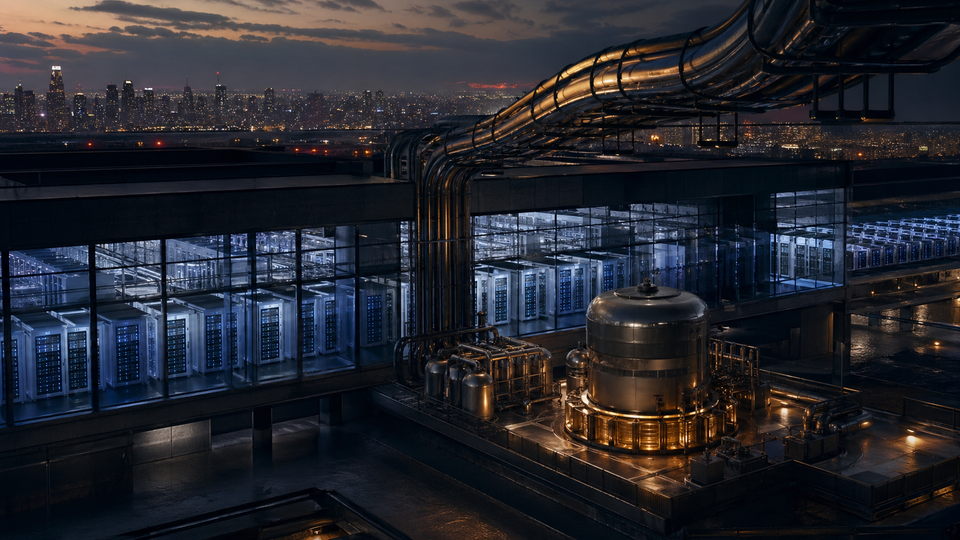
Every conversation about AI right now is about the foundational models. Which one is smartest. Which one is cheapest. Which one is closest to thinking. Almost nobody is talking about the buildings the models actually live in.
That's the story worth paying attention to. Because the next chapter of AI won't be decided by another billion parameters. It will be decided by whether we can build, power, cool, and connect the physical infrastructure that makes the models possible at all.
Welcome to the quiet, expensive, and increasingly strategic world of the data center.
The four-layer problem
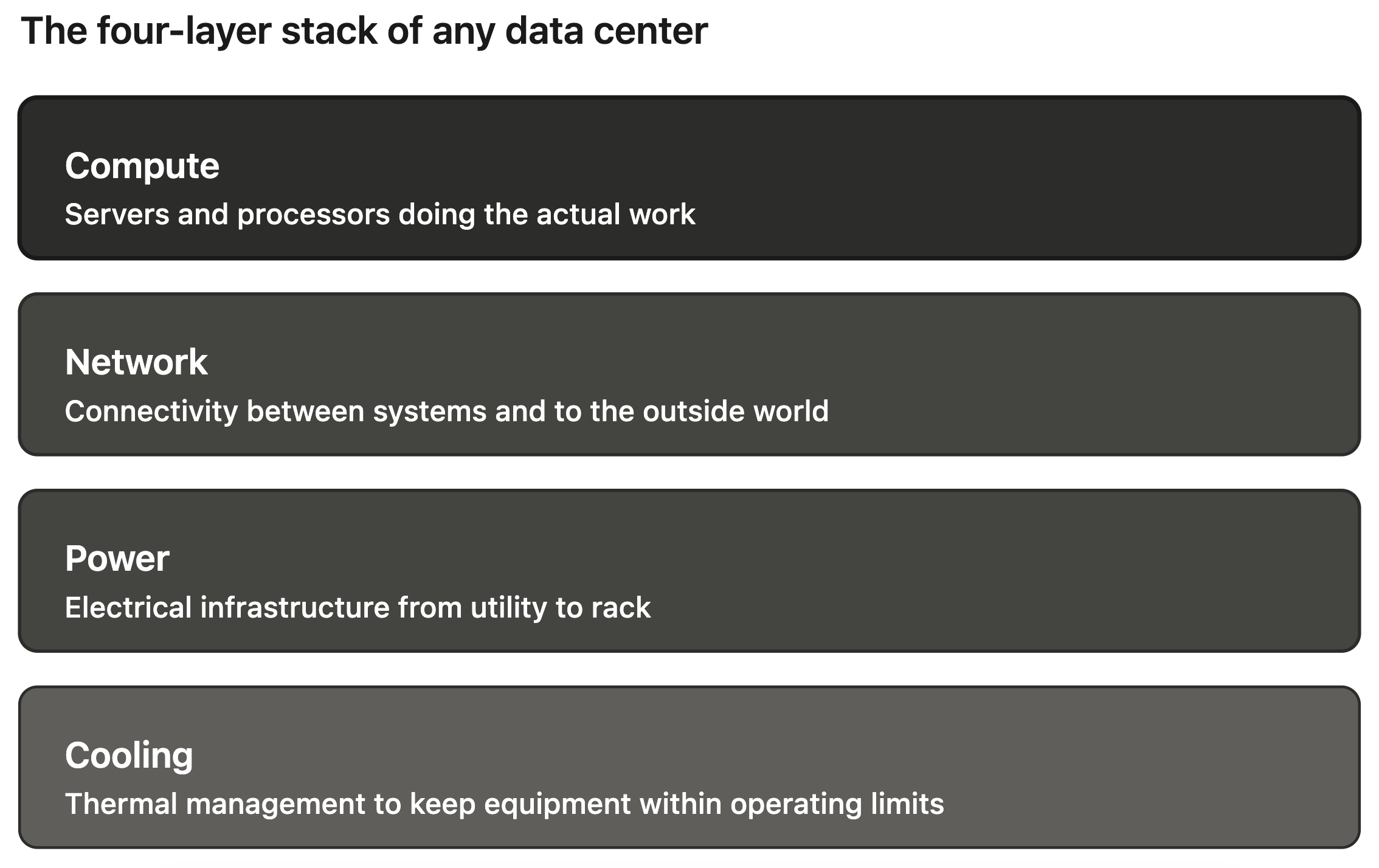
A data center is a purpose-built facility that houses compute, storage, and networking equipment to process, store, and distribute data at scale. Every data center, from a closet rack to a hyperscale campus, depends on four interdependent layers.
Compute is the servers and processors doing the actual work. Network is the connectivity between systems and to the outside world. Power is the electrical infrastructure from utility to rack. Cooling is the thermal management that keeps everything within operating limits. Everything else, physical security, fire suppression, monitoring, building controls, exists to protect those four layers.
Until recently, all four were in equilibrium. AI broke that equilibrium. The new generation of GPUs runs hot, draws absurd amounts of power, and demands network bandwidth that the previous generation of buildings was never designed for. NVIDIA's GB200 racks now pull 140 kilowatts each. The next generation is targeting 300 kilowatts. By 2027, single racks will exceed 600 kilowatts, and Google has already announced one-megawatt rack designs.
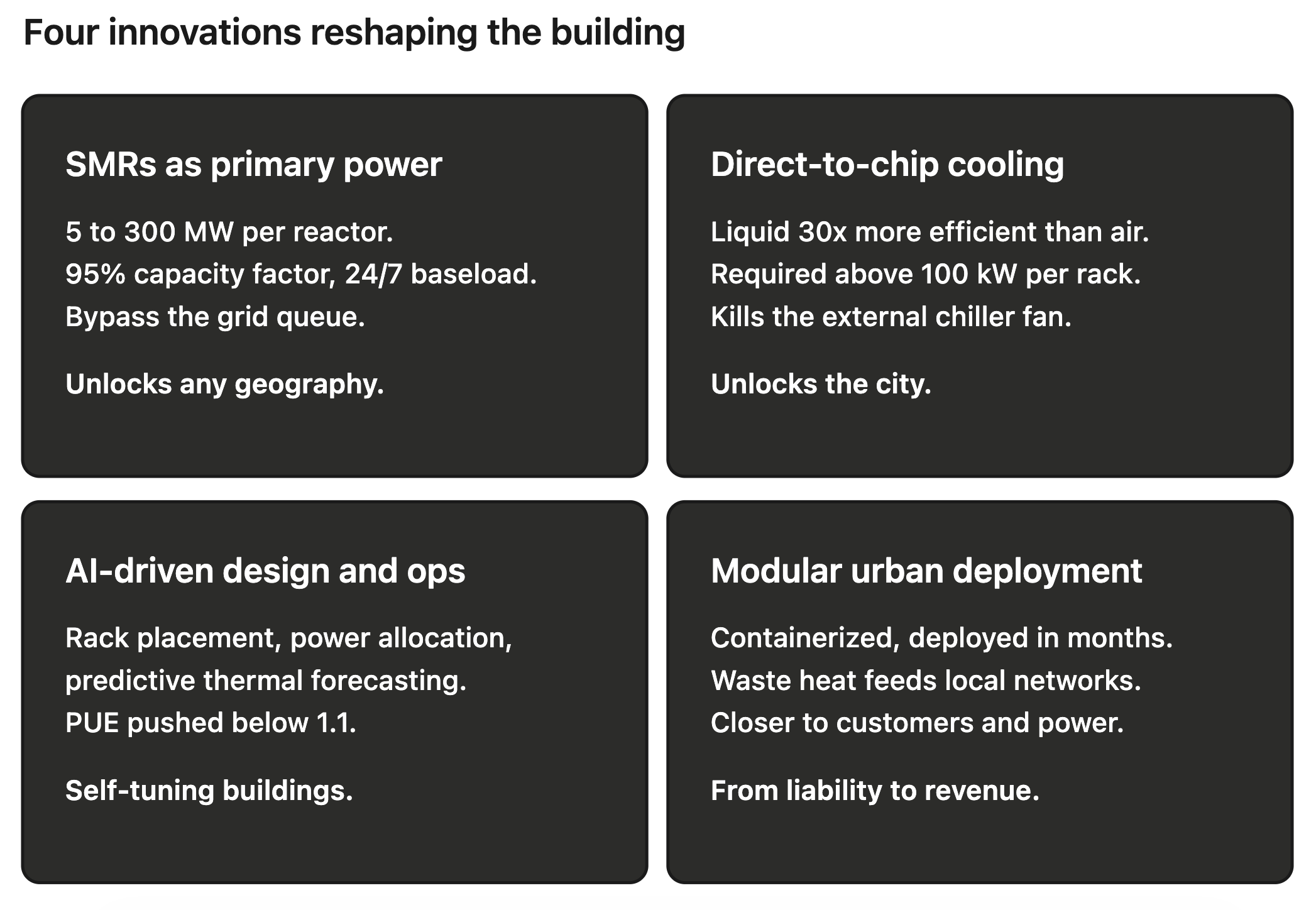
That's not an evolution. It's a different building. Four innovations are racing to redesign it.
Innovation 1: Small modular reactors come of age
The biggest constraint on AI growth right now isn't chips. It's electrons. The International Energy Agency (IEA) forecasts that data center electricity consumption will more than double by 2026, with AI-focused facilities already requiring 80 megawatts versus the 32 megawatts a standard data center used to need. Grid interconnection delays in the US now stretch up to a decade in some regions.
Small modular reactors, or SMRs, are the response. These are compact nuclear reactors producing 5 to 300 megawatts each, factory-built, transported to site, and assembled fast enough to scale alongside compute demand. They deliver a 95% capacity factor versus 25% for solar and 35% for wind. They run regardless of weather, time of day, or fuel market volatility.
Amazon, Google, and Microsoft have all signed deals. Oklo has a customer pipeline exceeding 14 gigawatts. AWS is investing $20 billion in Pennsylvania to co-locate SMRs with data centers. Deep Atomic has proposed a 60-megawatt SMR engineered specifically for AI workloads at Idaho National Laboratory.
The strategic implication is bigger than power. With self-contained baseload generation, you can put a data center anywhere. Cold remote regions become attractive again because cooling becomes free. Latency-sensitive workloads can co-locate with energy generation rather than waiting for transmission upgrades. And the same reactors paving the way for nuclear-powered AI campuses are paving the way for the fusion plants that come after.
Innovation 2: Direct-to-chip cooling kills the fan
Air cooling has hit its ceiling. The NVIDIA H100 runs at 700 watts. The B200 pushes past 1,200. You cannot move enough air across silicon that hot to keep it stable. Direct-to-chip liquid cooling, or DLC, has crossed from niche high-performance computing (HPC) labs to mainstream production, and now commands roughly 65% of the liquid cooling market.
The mechanics are elegant. A copper micro-channel cold plate mounts directly to the GPU package. Coolant flows through the plate, picks up the heat at the source, and carries it out of the rack through a coolant distribution unit (CDU). Liquid is roughly 30 times more efficient than air at moving heat. NVIDIA reports the GB200 NVL72 system achieves up to 25 times cost savings compared to its air-cooled equivalent, more than $4 million annually for a 50-megawatt facility.
The second-order effect is the interesting one. Once you stop relying on huge external chiller fans, the data center stops being loud. That removes one of the biggest barriers to building them in cities. Modular urban data centers, closer to customers and closer to power, become viable. Latency drops. Real estate efficiency improves. And the building stops looking like a hyperscale fortress in the desert.
Innovation 3: AI designs the data center that runs AI
The recursive moment has arrived. Operators are using AI to optimize the buildings that run AI. Rack placement, airflow modeling, power allocation, thermal forecasting, predictive maintenance, capacity planning. All the things that used to take a team of engineers weeks of design effort are now decided in minutes by models trained on operational data from existing campuses.
The biggest gains so far are in power utilization effectiveness (PUE), the industry's main efficiency metric. Modern AI-managed campuses are pushing PUE below 1.1, meaning more than 90% of every watt entering the building goes to actual compute rather than overhead. Five years ago, 1.5 was considered good.
The deeper implication is that data centers are becoming self-tuning systems. The building learns its own workload patterns and adjusts in real time. That's a fundamentally different operational model than the one the industry grew up on.
Innovation 4: Modularity unlocks the city
Modular data centers built from prefabricated containerized units can be deployed in months instead of years, sized to demand, and dropped into urban cores where the customers and the power already are.
The sustainability angle is where this gets interesting. A containerized 1-megawatt module in Honkajoki, Finland is now feeding the local district heating network with water at almost 80°C, providing roughly 20% of the agglomeration's heating needs. A 75-megawatt facility in Mäntsälä is heating around 2,500 homes. The European Energy Efficiency Directive now mandates that new data centers larger than 100 kilowatts perform a cost-benefit analysis for waste heat recovery.
Heat that used to be a liability is becoming a revenue stream. The same building that runs the model also heats the apartments above it. The circular economy showing up where nobody expected it.
What's coming next
Two ideas worth watching, both still on the edge of feasibility.
Standardization across hyperscalers. Today, every major operator builds custom designs, custom racks, custom cooling, custom controls. As demand outpaces supply chains, the pressure to converge on shared standards, the way EV charging connectors are converging, will become enormous. The first operator to lead a true open hardware standard for AI-era data centers will reshape the supply chain.
Offshore and submerged facilities. Microsoft's Project Natick proved a sealed seabed data center could run reliably for years with seawater handling cooling for free. Combine that with floating wind and wave power, and you get a data center that draws zero land, generates zero noise complaints, and uses the ocean as both coolant and host. Latency is the open question. So is regulation.
The quiet thesis
The story of AI in the next decade will not just be a story about better models. It will also be about whether we can build, power, cool, and connect the physical infrastructure to host them. The companies that win the next chapter will be the ones taking the buildings as seriously as the algorithms.