The Bridge Builders will Inherit the AI Wave

Most career and AI takes are either doom-scrolling fuel or generic "learn to vibe code" advice. Neither is useful.
The real story is more hopeful. The biggest opportunity in the AI economy isn't going to the people training foundational models. It isn't going to the laid-off knowledge workers told to retrain as plumbers either, because we cannot all become plumbers and electricians, and the trades market would collapse if we tried. The biggest opportunity is going to the people who can stand between two worlds and translate.
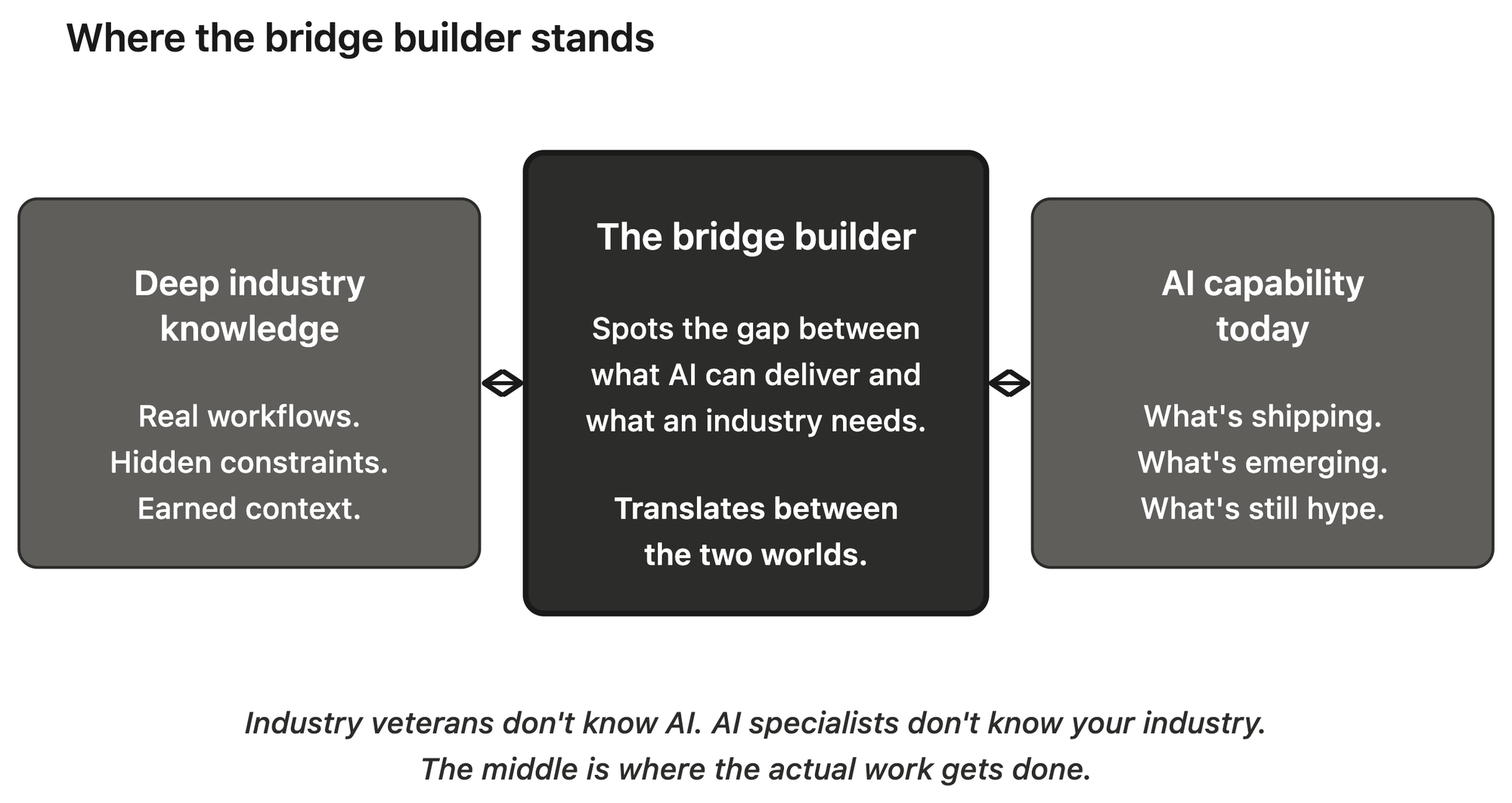
Bridge builders. People who understand how a real industry actually works, and who understand enough about what AI can do to spot the gap. That's the role that stealthily inherits the AI wave, and it doesn't require a PhD.
The numbers are louder than the headlines
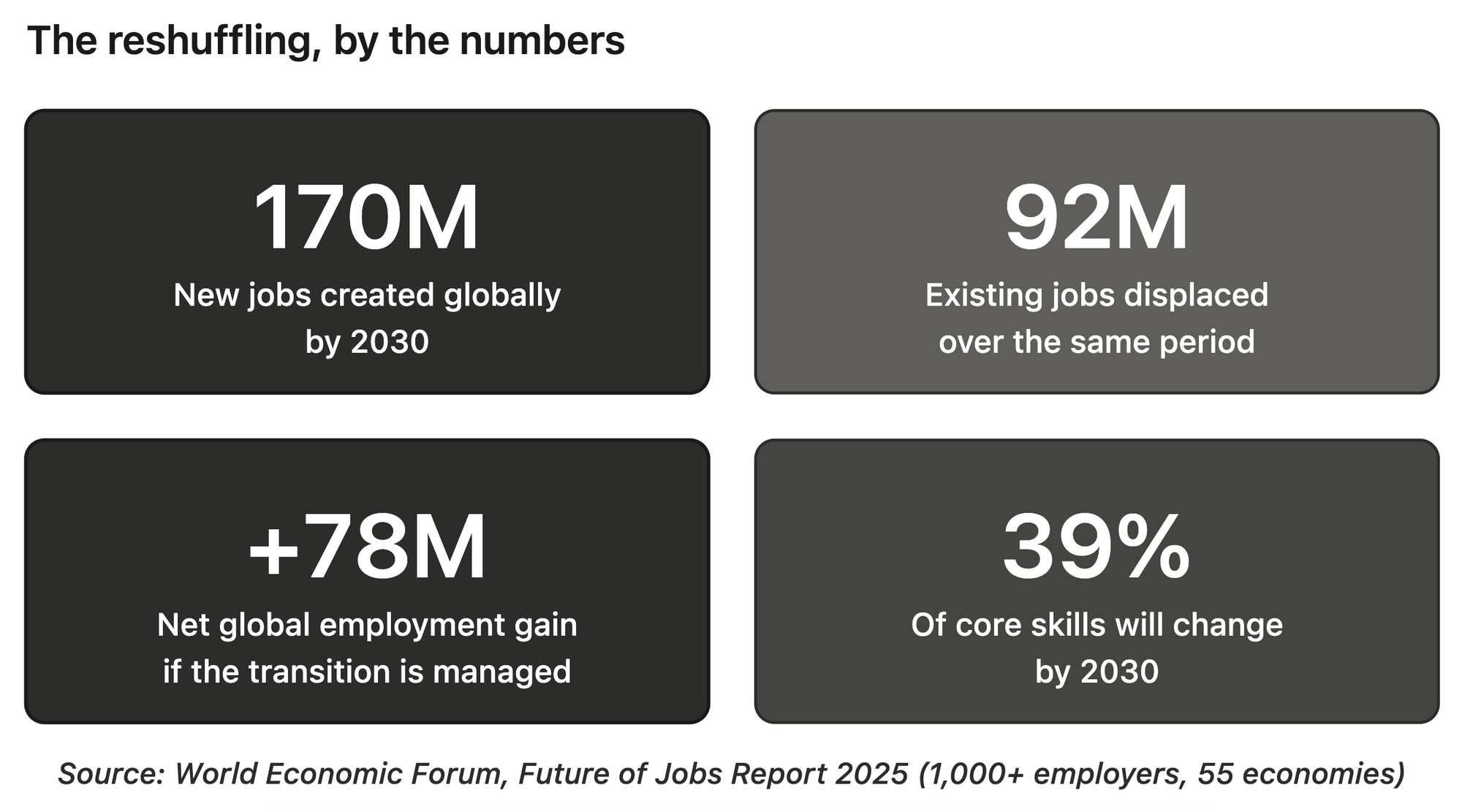
The World Economic Forum's Future of Jobs Report 2025 surveyed more than 1,000 of the world's largest employers, representing more than 14 million workers across 55 economies. The headline numbers tell a story most coverage flattens.
By 2030, 92 million jobs will be displaced. At the same time, 170 million new jobs will be created. The net is a gain of 78 million jobs globally. AI is the single largest driver of both numbers. 39% of workers' core skills will change by 2030. 63% of employers identify the skills gap as the primary barrier to transformation.
If you read only the displacement number, you panic. If you read only the creation number, you get complacent. The honest read is that an enormous reshuffling is underway, and the people who will do well in it are the ones who position themselves where the new jobs are forming, not where the old ones are dying.
The startup founder who never worked for a corporation
Let’s paint a real humbling scene that actually happened. At a venture capital pitch night, a young founder confidently declared his innovation would disrupt corporate communications. Email was finished. The future was something else entirely. When asked whether he had ever worked for a corporation, or any company of meaningful size, his answer was no.
If he had, he would have learned quickly that most businesses run on email. Meeting minutes, request for proposals (RFPs), multi-million dollar contracts, shareholder communications, board updates, vendor negotiations, legal trails, and yes, the office gossip too. Every one of those workflows has years of habit, regulation, and trust built around it.
You cannot disrupt an industry, or even the way a single demographic works, if you have never been inside it. You can build something clever, but you will not build something useful, and the gap between clever and useful is where most startups die.
Why your boring resume is actually your edge
For young people starting out, and for anyone rebuilding a career mid-stream, the most counterintuitive advice in the AI era is this: go work somewhere real before you try to disrupt anything.
Not because the job will be glamorous. It probably won't. But because there is no substitute for sitting inside an industry long enough to see where the seams actually are. To understand which workflows are broken, which ones look broken but are load-bearing, which ones are inefficient on purpose because of regulation, and which ones nobody has ever bothered to question.
This is not just about earning a paycheck while learning on someone else's dime, though that's a real benefit. It's about building the only asset that AI cannot easily replicate: deep, lived, tribal knowledge of how a specific industry actually operates. That knowledge becomes your moat the moment you decide to build something on top of it.
The founders who succeed in industrial AI, healthcare AI, legal AI, or financial AI almost always spent years inside those industries first. They earned their problem statements before they tried to solve them.
How to ride the wave instead of drowning in it
Once you have the experience, the question becomes how to combine it with what AI can now do. Here's the framing that works regardless of whether you're technically inclined, people-oriented, or somewhere in between.
Be the connective tissue. Find a real-world pain point in an industry you actually understand. Map it against what AI tools and infrastructure can plausibly deliver in the next twelve to twenty-four months. Look for the gap where the technology is ready but the deployment hasn't happened yet, especially in niche industries the big AI labs are not paying attention to.
That gap is your calling card. It does not require you to train models. It does not require you to be the smartest engineer in the room. It requires you to know one industry deeply, to be curious enough to keep up with what AI can do, and to be patient enough to translate between the two.
People who can do this will be invaluable for the next decade. Not because the role is glamorous, but because almost nobody else can do it. The AI specialists don't know your industry. The industry veterans don't know AI. You're standing in the empty middle, and the middle is where the actual work gets done.
Be selfish in your learning
There's a lot of fear-mongering right now about AI-driven layoffs and forced reskilling. Some of it is justified. Most of it is noise. The most useful response, especially if you're not knee-deep in foundational model training and you're not yet drowning in AI tools at your current job, is to get selfish about your own learning.
Selfish in this case means specific. Don't try to learn AI in general. That's a losing game and the field moves too fast. Instead, ask which AI capability you can apply to a problem you already understand from experience. Then go learn just enough of that capability to ship something useful, even if it's small. Then do it again. Then again.
The euphoria of riding a bicycle for the first time, of unlocking a new skill, of seeing a system click into place, comes from being curious and leaning in. Not from doom-scrolling. Not from waiting for someone to retrain you. From sitting down and starting.
In a sea of fear, curiosity is the competitive advantage that you should be using.
The path forward
The next decade will not reward the people who panic, and it will not reward the people who pretend nothing is changing. It will reward the bridge builders. The people with one foot in a real industry, one foot in what AI can now do, and the patience to translate between them long enough to ship something that matters.
That role does not require you to abandon your experience. It requires you to use it as the most valuable asset you have, because the AI wave still needs a shore to break against, and that shore is built out of the everyday knowledge of how things actually work.
If you have that knowledge, you are not behind. You are exactly where the next decade needs you to be.